

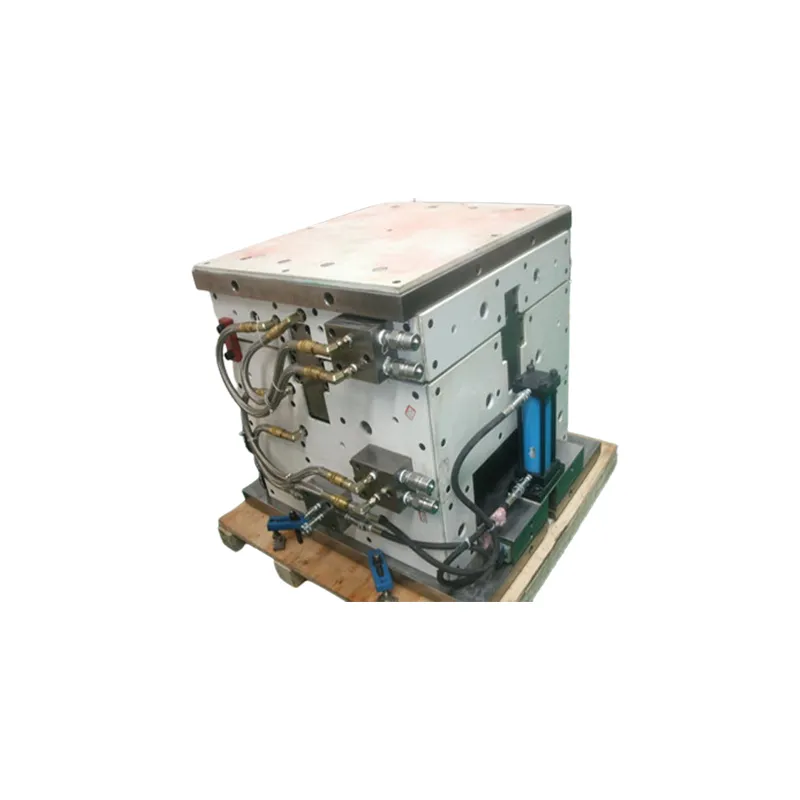
In modern composite manufacturing, the demand for durable, lightweight, and cost-effective components is rising rapidly. The SMC mold (Sheet Molding Compound mold) has become the backbone of high-volume production for automotive parts, electrical enclosures, and construction panels. DERCO, a leading mold manufacturer, integrates international CAD/CAM/CAE systems to deliver SMC mold design, High temperature mold, Large tools, and Custom insert molding solutions. This article provides technical data, application cases, and selection criteria to help engineers and procurement managers make informed decisions.
1. Why SMC Mold Technology Drives Mass Production
A standard SMC mold consists of two hardened steel halves that withstand clamping forces up to 2,500 tons and curing temperatures between 140°C and 160°C. Unlike injection molds, SMC mold cavities are designed for thermosetting resin mixed with 25–50% chopped glass fibers (12–25 mm length). This structure produces parts with flexural strength exceeding 200 MPa and heat deflection temperature above 200°C.
DERCO’s SMC mold portfolio covers watt-hour meter boxes, transformer distribution boxes, outdoor ring network cabinets, automotive body panels (hoods, fenders), new energy vehicle battery box covers, building material templates, and wall panels. Each SMC mold undergoes rigorous fatigue testing – minimum 500,000 cycles without surface wear.
Key Data for SMC Mold Performance
| Parameter | Value Range |
|---|---|
| Mold steel hardness | 48–52 HRC (heat-treated) |
| Max cavity pressure | 180–220 bar |
| Curing time per part | 60–180 seconds |
| Dimensional tolerance | ±0.05 mm (for automotive class A surfaces) |
| Surface roughness | Ra ≤ 0.4 μm |
2. Precision SMC mold design for Complex Geometries
Effective SMC mold design directly influences part quality and cycle efficiency. DERCO employs UG, Pro-E, SolidWorks, IDEAS, and CATIA to simulate material flow, temperature distribution, and shrinkage compensation. SMC shrinks at 0.1–0.3% after curing – our SMC mold design incorporates tapered ribs and optimized gate positions to prevent voids or fiber orientation defects.
For a recent new energy vehicle battery box cover project (1,200 mm × 800 mm × 150 mm), our SMC mold design reduced flash by 42% compared to conventional designs. The mold’s venting gap of 0.03–0.05 mm eliminated air traps, achieving a reject rate below 0.8% in mass production.
Best practice for buyers: Request a mold flow analysis report before approving SMC mold design. DERCO provides free CAE simulation data showing pressure drop, weld line location, and thermal gradient – critical for parts requiring UL 94 V-0 fire rating or IP67 sealing.
3. High temperature mold Engineering for Thermoset Curing
The SMC process requires a High temperature mold because the thermosetting resin crosslinks at 140–160°C. Standard P20 steel cannot maintain flatness above 120°C. DERCO builds High temperature mold using H13 or 1.2344 tool steel, which retains hardness up to 550°C. Each High temperature mold includes electric cartridge heaters (power density 4–6 W/cm²) or oil channels with temperature control accuracy of ±3°C.
A High temperature mold from DERCO typically has a heating ramp rate of 2–3°C per minute, reaching 150°C in under 50 minutes. Uneven heating causes warpage – our High temperature mold uses six independently controlled zones for large surfaces. In a field test for truck fender production, a properly designed High temperature mold reduced scrap from 7% to 1.2% by eliminating under-cured edges.
“For parts with thickness variations (e.g., 2 mm to 8 mm ribs), a High temperature mold with zone control is non-negotiable. DERCO’s thermal imaging shows a maximum deviation of only 5°C across a 1.5 m mold plate.” – Senior Process Engineer, DERCO.
4. Large tools for Oversized Composite Components
Automotive body panels, distribution cabinets, and building wall panels often exceed 1.5 meters in one dimension. Manufacturing Large tools requires heavy-duty steel plates (minimum 150 mm thickness), stress-relieving heat treatment, and high-rigidity machining centers. DERCO produces Large tools up to 3,000 mm × 2,000 mm with a total weight of up to 12 tons.
Challenges with Large tools include thermal expansion (approx. 0.011 mm/m/°C) and deflection under clamp force. Our Large tools incorporate steel rib supports every 300 mm, reducing deflection to under 0.1 mm at 2,000 tons clamping. For a solar industry customer producing 2.2 m × 1.8 m inverter enclosures, our Large tools achieved cycle consistency of ±0.3 seconds over 24-hour continuous runs.
Selection advice for large tools:
For annual volumes < 20,000 parts, pre-hardened steel Large tools (38–42 HRC) are cost-effective.
For volumes > 50,000 parts, specify through-hardened Large tools (48–52 HRC) with nitride coating – DERCO offers this as standard.
Ask about split-cavity Large tools – they simplify maintenance and reduce replacement cost by 40% if one section wears.
5. Custom insert molding Integration with SMC Molds
Many applications require metal inserts (threaded bushings, brackets, or sensor housings) embedded during molding. Custom insert molding positions brass or stainless steel inserts inside the SMC cavity before material injection. DERCO specializes in Custom insert molding for watt-hour meter boxes and EV battery connectors – inserts are pre-heated to 120–140°C to avoid thermal shock.
A Custom insert molding process must ensure pull-out force > 2,000 N for M6 inserts. DERCO’s Custom insert molding design uses tapered knurled inserts and zero-clearance positioning pins. In a transformer box project with 14 stainless steel inserts per part, our Custom insert molding reduced insert misalignment from 5% to 0.3% using optical positioning guides.
Key specifications for custom insert molding:
Maximum insert size: 120 mm × 60 mm × 30 mm
Insert material compatibility: brass, steel, aluminum, copper
Positioning accuracy: ±0.03 mm
Pull-out strength: up to 3,500 N (M8 insert)
6. Quality Assurance and Global Delivery Standards
DERCO follows international protocols for all SMC mold exports. After CNC machining and EDM finishing, each SMC mold is assembled and tested on a 500-ton or 1,000-ton press. We provide:
Full dimensional report (CMM measurement, 150+ checkpoints)
Material certificate (for steel, heaters, sensors)
Spare parts kit (heating rods, thermocouples, ejector pins)
Electrodes for SMC mold cavity repair (available on request)
All SMC mold packaging meets standard export requirements – vacuum-sealed anti-rust paper, wooden crates with silica gel, and steel strapping. Sea or air delivery does not affect the mold surface. DERCO also supports DME and HASCO standards for Custom insert molding components.
7. Decision Guide: Choosing the Right SMC Mold Solution
| Your Requirement | Recommended Solution from DERCO |
|---|---|
| Parts with deep ribs or undercuts | SMC mold design with slide cores or lifters |
| Continuous 24/7 operation | High temperature mold with H13 steel + oil heating |
| Molding surface > 1.5 m² | Large tools with ribbed support plate |
| Embedded metal parts (threads, contacts) | Custom insert molding with pre-heated inserts |
| High gloss class A surface | SMC mold with chromium-plated cavity (Ra 0.05 μm) |
Contact DERCO for Your SMC Mold Project
DERCO has delivered over 1,200 SMC mold units to automotive, energy, and construction industries since 2010. Our technical team provides free initial CAE analysis, 3D mold design review, and on-site trial support. For quotations or technical discussions, please contact:
WhatsApp: +86 136 2095 8219
Email: Sales@derco-mould.com
Services: SMC mold design consultation, High temperature mold simulation, Large tools engineering, Custom insert molding prototyping, and full SMC mold manufacturing.
